Overview
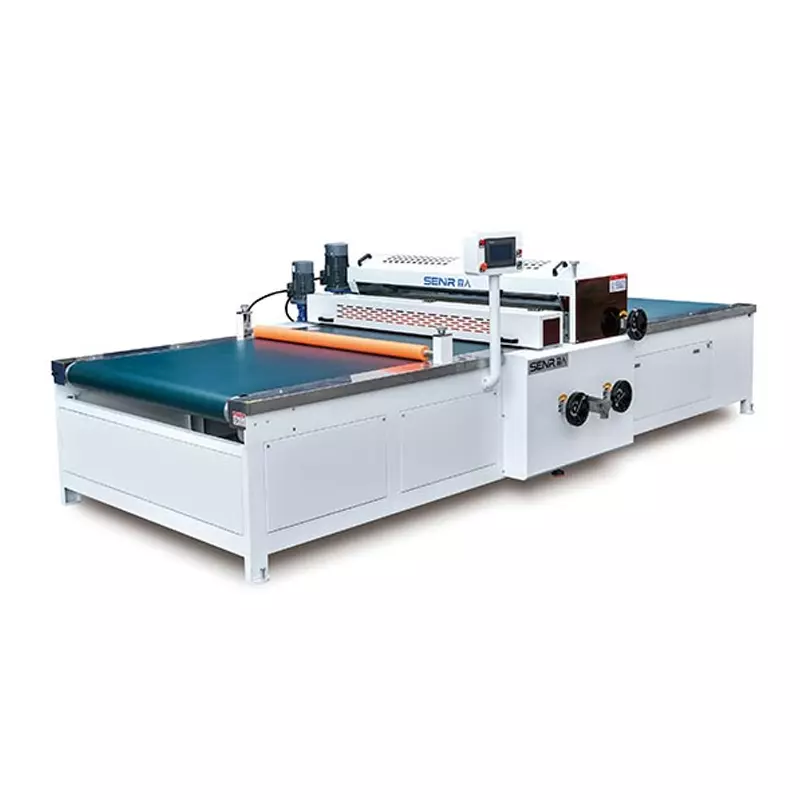
The Photovoltaic Glass Coating Machine is a high-precision roller coating system specifically designed for applying anti-reflective (AR) coating onto photovoltaic glass substrates-. This coating reduces the amount of light reflected from the glass surface, allowing more sunlight to pass through and thereby improving the overall efficiency of solar panels.
Developed with advanced roller coating technology, this machine applies AR coating solutions uniformly onto the surface of flat tempered glass, producing photovoltaic glass with significantly enhanced light transmittance. Compared to traditional coating methods such as sputtering, dip-coating, spraying, curtain coating, or spin-coating, the roller coating process offers superior production efficiency, higher film uniformity, and easier process control.
The machine is designed for seamless integration into a complete AR coating production line, typically consisting of glass washing, AR coating application, drying, and curing stages. It is an essential solution for manufacturers in the solar energy industry seeking to produce high-performance, cost-effective photovoltaic glass panels.
Working Principle
The Photovoltaic Glass Coating Machine operates on a precision roller coating mechanism. The equipment consists of a coating rubber roller, a feeding steel roller, a leveling steel roller, positioning rubber rollers, a belt conveyor system, a coating solution delivery and circulation unit, and support rollers.
Pre-cleaned photovoltaic glass is conveyed into the coating zone via the belt conveyor system. The coating solution is delivered to the feeding steel roller and evenly transferred to the coating rubber roller through the leveling steel roller. The coating rubber roller, rotating in the opposite direction to the glass feed direction, applies a uniform, continuous film of AR coating solution onto the glass surface. This counter-directional rotation ensures precise film thickness control and eliminates coating defects such as streaks or unevenness.
The coated glass then proceeds to subsequent drying and curing stages, where the AR film is stabilized and hardened, resulting in a durable, high-performance anti-reflective coating ready for further processing in a tempering furnace.
Applications
The Photovoltaic Glass Coating Machine is specifically designed for the solar energy industry, with primary applications including:
The machine can handle various photovoltaic glass types, including patterned solar glass and float glass, with thicknesses ranging from 2mm to 6mm (standard 3.2mm).
Key Features & Benefits
Technical Specifications (Reference)
Note: Specifications may vary by model and configuration. Please consult our sales team for detailed specifications tailored to your specific requirements.
System Configuration
A complete photovoltaic glass AR coating production line typically includes the following components:
-
Glass Washing Machine – Pre-cleaning to remove dust, oil, and contaminants from glass surface
-
Preheating Section – Electric heating to remove residual moisture (temperature: ambient to 150°C adjustable)
-
Photovoltaic Glass Coating Machine – Precision roller coating of AR solution onto glass surface
-
Leveling / Drying Tunnel – IR heating for solvent evaporation and film leveling (length: 11.25m)
-
Tempering Furnace – Thermal tempering to finalize AR coating and strengthen glass
-
Cooling Section – Forced air cooling of finished products
-
Control System – PLC with HMI touchscreen for centralized monitoring and control
Summary
The Photovoltaic Glass Coating Machine represents a state-of-the-art solution for the production of high-performance AR-coated photovoltaic glass. By utilizing advanced reverse roller coating technology, it delivers superior film uniformity, high production efficiency, and excellent optical performance – all at a lower operating cost compared to traditional coating methods.
Whether you are producing solar panels for utility-scale power plants, building-integrated photovoltaics, or specialized solar glass applications, this machine provides the precision, reliability, and scalability you need to meet growing market demands. With its robust construction, user-friendly controls, and seamless integration capabilities, it is the ideal choice for manufacturers seeking to enhance their photovoltaic glass production capabilities.