
What are the key daily process control points for a solar-control glass roller coater?
Description of Equipment and Process:
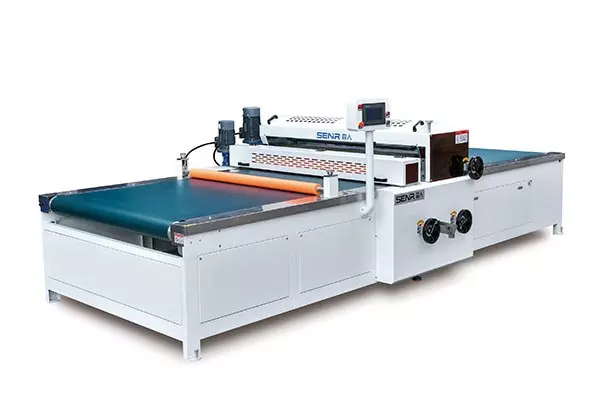
The solar-control glass roller coater is a dedicated coating machine for flat architectural and household glass. It uses a metering steel roller paired with a polyurethane applicator roller to apply solar-control insulating coatings (such as UV-curable solar-control coatings, water-based nano heat-insulating coatings, and infrared-blocking coatings) evenly onto the glass surface. After drying/UV curing, a solar-control insulating film is formed that blocks UV and infrared rays and reduces light transmission and heat absorption.
The solar-control coating is stored in a temperature‑controlled trough and fills the gap between the metering steel roller and the applicator roller. The two rollers rotate independently in opposite directions: the steel roller scrapes off excess coating and precisely controls the wet film thickness. The glass passes under the applicator roller at a constant speed, and the coating is uniformly transferred onto the glass surface. The coated glass then enters a drying tunnel, where cast aluminium heating plates provide gradient heating to evaporate solvents, or UV lamps initiate crosslinking curing, forming a dense solar-control functional film. Excess coating is automatically recycled and returned, resulting in very low material loss.
Daily Process Control Points
-
Roller Gap and Speed Matching
-
-
When the viscosity of the solar-control coating increases, appropriately enlarge the gap between the steel roller and the rubber roller.
-
Keep the conveyor speed and the applicator roller linear speed synchronized to prevent coating build‑up at the glass edges or missed areas at the head/tail.
-
Calibrate roller parallelism daily using a micrometer.
-
-
-
Temperature Control of Coating Supply
-
-
The viscosity of solar-control nano‑coatings is highly temperature‑sensitive; maintain the trough temperature at 25±2 °C.
-
Check the coating viscosity at the start of each shift and add thinner as necessary.
-
Drying Control with Cast Aluminium Heating Plates
-
-
Use a three‑stage stepwise heating profile (low‑temperature leveling → medium‑temperature volatilization → high‑temperature curing); never apply high temperature directly.
-
Regularly clean carbon deposits on the heating plates to prevent local overheating and blistering of the coating layer.
-
Clean the air duct filters weekly to ensure uniform hot‑air circulation.
-
Roller Maintenance
-
- After daily shutdown, clean the steel roller and rubber roller with dedicated solvents to prevent the solar‑control coating from drying and caking.
-
Avoid scratching the rubber roller with hard objects; replace it every 3–6 months.
-
Regularly lubricate bearings with grease (using a pneumatic grease gun).
-
Pre‑treatment Control
-
-
Maintain stable air‑knife pressure so that no water residue remains on the glass surface.
-
Check the plasma unit power daily; perform a water‑drop test on the glass surface to confirm the dyne value meets the standard, ensuring good adhesion of the solar‑control coating.
-
Exhaust and Safety Control
-
-
For solvent‑based solar‑control coatings, the exhaust system must be running; ozone generated during UV curing must be extracted promptly.
-
Use explosion‑proof motors and sealed electrical controls in the workshop.